
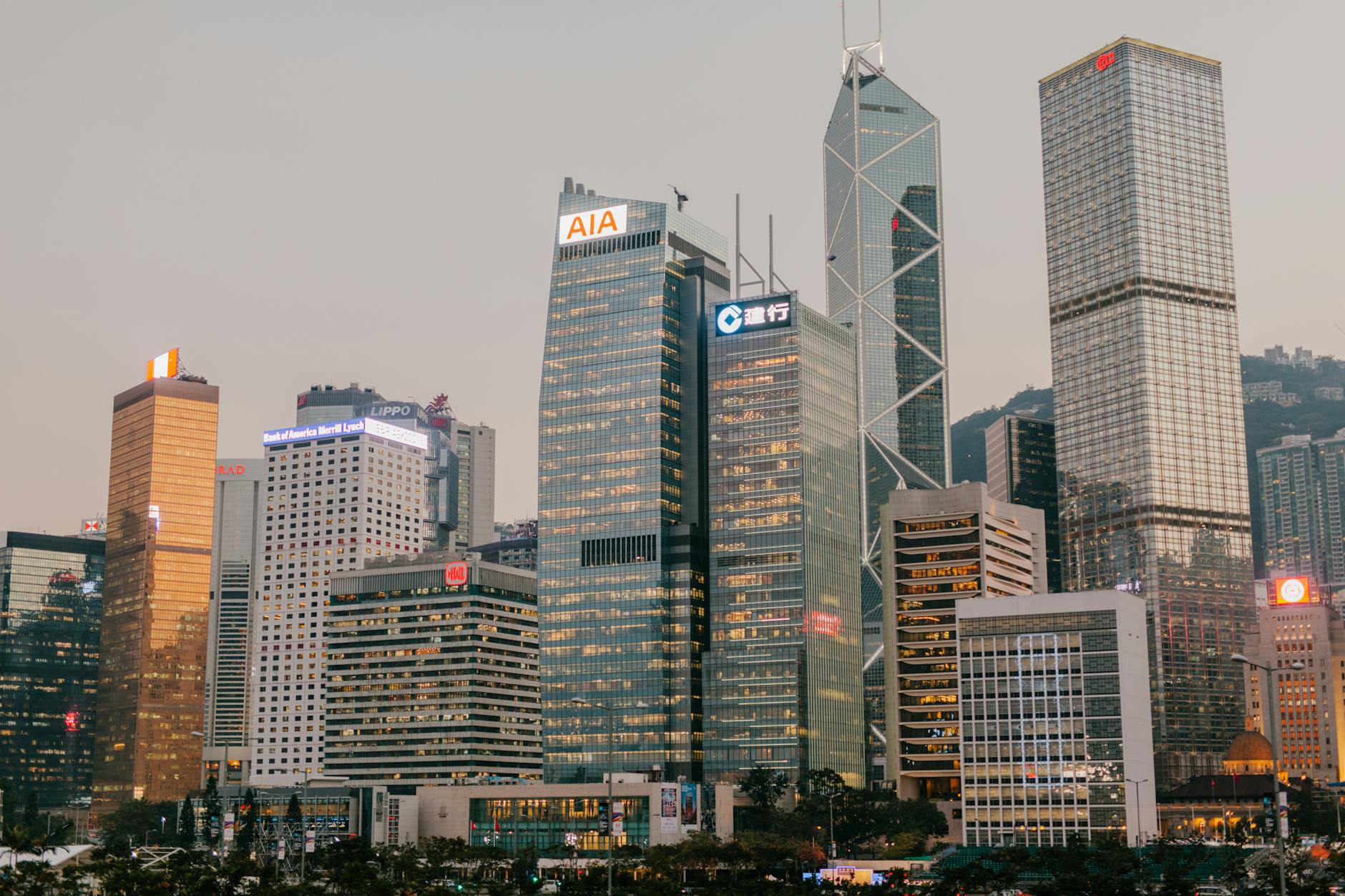
Two graduates accept their first jobs the same week — one in Hong Kong, one in Singapore — on roughly the same salary. A year later, the Hong Kong one has noticeably more spendable cash in the bank, and the Singapore one has a growing balance they can’t actually touch. Neither did anything wrong. They just live under two tax systems that look similar on the surface and behave completely differently once you trace where the money goes.
Hong Kong’s setup is brutally simple: a low, flat-capped salaries tax and a small mandatory pension contribution, and that’s basically it. Singapore runs a hybrid — a genuinely progressive income tax that starts at zero and climbs in modest steps, layered on top of the Central Provident Fund (CPF), a compulsory savings scheme that takes a large slice of your pay from both employee and employer sides. The income-tax rates in Singapore actually look gentle next to Hong Kong’s for many mid-range incomes. It’s CPF that flips the whole comparison.
Effective tax rates: where the thresholds bite
If you only compared income tax, Singapore would look competitive — its bottom bands are taxed at zero or low single digits, and a fresh graduate’s effective income-tax rate stays small. Hong Kong’s salaries tax, after the basic allowance, also lands at a low effective rate for graduate-level pay; it stays well under the headline cap until you’re earning a lot.
The picture only diverges once you add the mandatory savings layer. In Hong Kong that layer is tiny — the pension contribution is a small, capped percentage. In Singapore, CPF is the heavyweight: a graduate under 55 hands over a large fifth-ish chunk of salary as the employee share alone. Stack income tax and CPF together and a typical Singapore graduate sees roughly a fifth or more of gross pay disappear into compulsory deductions, while the Hong Kong equivalent loses only a low single-digit percentage. That gap holds, and even widens a little, as graduate salaries climb.
So the pattern is consistent: on pure tax, the two cities are in the same league. On total mandatory deductions, Hong Kong leaves you with far more cash in hand.
The CPF factor: forced savings or hidden tax?
CPF is the single biggest reason Hong Kong and Singapore graduate take-home pay diverge, so it’s worth being clear-eyed about what it is. Hong Kong’s Mandatory Provident Fund (MPF) asks for a small, capped employee contribution with a matching employer share — modest enough that most graduates barely notice it. Singapore’s CPF asks for a large employee contribution for anyone under 55, with no relief on the first chunk of monthly income, plus a sizeable employer contribution on top.
Here’s the catch that trips people up: you only ever see the employee share leave your payslip, but the money lands in accounts you can’t freely spend. CPF funds are earmarked for housing, healthcare, and retirement, and they’re locked for most other purposes. So while a Singapore graduate is technically accumulating wealth, their week-to-week spending power is cut by the full employee contribution. The employer’s CPF share never touches their hands at all.
Net it out and a Hong Kong graduate on a typical local starting salary keeps the large majority of gross income as discretionary cash after tax and pension. A Singapore graduate at the equivalent level keeps meaningfully less — roughly three-quarters to four-fifths. Over a few years, that difference in liquid cash flow compounds into real money, even though the Singapore graduate’s net worth on paper isn’t necessarily lower once you count the CPF balance.
What it looks like across graduate profiles
Walk it up the salary ladder and the same story repeats. A bachelor’s-level hire in a general business role keeps a high share of gross pay as cash in Hong Kong, and a noticeably lower share in Singapore once CPF is taken out — and adjusting for purchasing power doesn’t close the gap, it mostly leaves Hong Kong ahead on real spendable income. A master’s-level hire in finance or tech sees the same shape; even after accounting for Singapore’s consumption tax (which Hong Kong doesn’t levy), the Hong Kong graduate holds a clear lead in net spending power. A PhD or post-MBA hire on a higher salary keeps the largest absolute cash advantage of all, because CPF takes a bigger bite as the salary grows.
This liquidity gap is exactly what graduates weigh when they hold offers from both cities. Among the master’s-level applicants UNILINK has worked with, the difference in cash take-home was the most common reason cited by those who picked Hong Kong. But it wasn’t unanimous — a substantial share chose Singapore anyway, pointing to long-term residency pathways and CPF’s housing benefits as worth the lower up-front cash.
Filing and the bigger tax picture
Both systems are about as painless as tax administration gets. In Hong Kong, the Inland Revenue Department issues a return, the basic allowance applies automatically, there are no CPF-style deductions to wrangle, and most graduates can finish filing in well under an hour; the tax year runs April to March with returns due in early May. Singapore’s filing is also clean — CPF is reported automatically by employers — but you do have to claim a few reliefs yourself, such as earned income relief, course fees, or charitable donations, and the tax year is calendar-based with electronic returns due in mid-April. The compliance gap between them is small.
The psychological gap is not. Handing a fifth of your salary every month to an account you can’t open for decades feels like a tax to most graduates, whatever the government calls it. And Hong Kong sweetens its side further by having no capital gains tax, no estate duty, and no sales tax — so a graduate who invests from their larger cash position keeps every dollar of gains. Singapore also leaves capital gains untaxed, but you’re investing from a smaller pool of free cash, so the compounding starts slower.
Which means the real decision isn’t “which city taxes less.” It’s what you value. If you want maximum liquid cash now and plan to leave Asia within five to ten years, Hong Kong’s structure is the clear winner. If you intend to put down roots, buy property, and stay long-term, CPF stops looking like a deduction and starts looking like a head start on a house and a pension — a feature rather than a bug.
FAQ
Q1: What is the effective tax rate for a graduate earning HKD 360,000 in Hong Kong in 2026?
After the basic allowance of HKD 132,000, chargeable income is HKD 228,000. Tax is HKD 2,640 on the first HKD 132,000 (2%) plus HKD 5,760 on the next HKD 96,000 (6%), totaling HKD 8,400. The effective income tax rate is 2.3%. Including MPF (5% capped at HKD 1,500/month), total deductions are HKD 18,000, leaving net cash of HKD 342,000 (95.0% of gross).
Q2: How does Singapore CPF affect a graduate earning SGD 60,000 in 2026?
The employee CPF contribution is 20% of SGD 60,000 = SGD 12,000 per year. Income tax on chargeable income of SGD 40,000 (after SGD 20,000 personal relief) is SGD 1,950. Total deductions = SGD 13,950, or 23.3% of gross. Net cash take-home is SGD 46,050 (76.7% of gross). The employer CPF of SGD 10,200 is not deducted from salary but is an additional cost to the employer.
Q3: Which city offers higher net savings potential for a graduate over three years?
Assuming a graduate saves 20% of net cash, a Hong Kong graduate earning HKD 360,000 saves HKD 68,400 annually (HKD 205,200 over three years). A Singapore graduate earning SGD 60,000 saves SGD 9,210 annually (SGD 27,630 over three years). Even after adjusting for cost-of-living differences, the Hong Kong graduate accumulates 2.5x to 3x more liquid savings in the same period.
Q4: How does the total tax and mandatory contribution burden compare for a graduate earning HKD 480,000 (SGD 84,000) in 2026?
In Hong Kong, salaries tax on HKD 480,000 (after basic allowance) is HKD 14,940 (effective rate 3.1%). MPF contribution is HKD 18,000 (5% capped). Total deductions: HKD 32,940 (6.9% of gross). Net cash: HKD 447,060 (93.1%). In Singapore, income tax on SGD 84,000 (chargeable after relief) is SGD 3,350 (effective 4.0%). Employee CPF at 20% is SGD 16,800. Total deductions: SGD 20,150 (24.0% of gross). Net cash: SGD 63,850 (76.0%). The Hong Kong graduate retains 17.1% more of gross income as cash.
Q5: What are the differences in tax filing deadlines and reliefs between Hong Kong and Singapore?
Hong Kong’s tax year runs April 1 to March 31, with returns due by early May. Basic allowance of HKD 132,000 is automatic; no additional relief forms needed. Singapore’s tax year is January to December, with returns due April 15 (electronic filing). Graduates can claim earned income relief (up to SGD 1,000 under 55), course fees relief (up to SGD 5,500), and charitable donations (2.5x qualifying amount). In 2026, the personal relief for Singapore residents is SGD 20,000, reducing chargeable income directly.
References
- Hong Kong Inland Revenue Department, 2026, Salaries Tax Tables and Allowances
- Inland Revenue Authority of Singapore, 2026, Individual Income Tax Rates and Reliefs
- Central Provident Fund Board, 2026, Contribution Rates for Employees Under Age 55
- UNILINK, 2026, Graduate Salary and Tax Tracking Report (n=780 applicants)
- Hong Kong Mandatory Provident Fund Schemes Authority, 2026, Contribution Cap and Rules
- Singapore Department of Statistics, 2026, Report on Labour Market and Wage Changes